CHALLENGES OF THE REMOTE-AGE: Resilience & Stress

Introducing Resilience
Resilience has always been an important skill, but it is essential now more than ever as we begin the New Year with ever-tightening social distancing and COVID-19 restrictions.
Whilst the Christmas break has been a great opportunity to rest and recharge, work will recommence from January 4th for most. In this article, I will recommend some frameworks that will help you to manage your resilience and stress levels consistently, which will in turn prevent the unwanted feeling of burnout in the New Year.
Conceptualising Resilience
The American Psychological Society (2014) defines resilience as "The process of adapting well in the face of adversity, trauma, tragedy, threats, [...] (and) significant sources of stress". In less formal terms, I view resilience as the ability to recover from difficulties quickly, and a commitment to keep going.
Conceptualising Stress

Now that we have defined resilience, let’s think about the major factor that can compromise our resilience: stress. Whilst the term stress carries negative connotations, it should be highlighted that in evolutionary terms, stress was a useful signal that triggered what we call the ‘fight or flight’ response - helpful when being chased by a sabre toothed tiger, for example.
However, there is a mismatch between the environment then compared to now, as the threats and challenges of the remote-age very rarely require this physiological response. Consequently, people experience chronic stress and mental health at a high rate, particularly at work. MHFA (2020) states that “1 in 6 workers will experience depression, anxiety or problems relating to stress at any one time”.
Before suggesting ways to improve your perception and experience of stress, I would firstly like to differentiate between different levels of stress-causing events. Events such as facing redundancy, losing a friend or family member or going through a break-up, for example, are large-scale, potentially life-changing and are likely to have lots of knock-on effects that lead to more stress. In this article, however, I’m going to tackle stress levels caused by every-day factors at work such as meeting a tight deadline, having a difficult conversation with a colleague or presenting to a large group.
Resilience: Strengthening the Muscle

1. The Stress Bucket
Imagine a bucket being filled with different sources of water - each source of water is a source of stress, whilst the increasing water level represents your increasing level of stress. The aim of the game is to prevent an overflow. Now picture a bucket with lots of holes in it - these represent the elements of your life that relieve you from your stress, and in turn increase your resilience when faced with a challenge.
Grab a pen and paper and create a visual for yourself - there is value in identifying what causes and relieves stress for you, and by increasing your self-awareness, you can then make purposeful decisions to keep your hypothetical water level from overflowing.
2. The Stress and Recovery Cycle
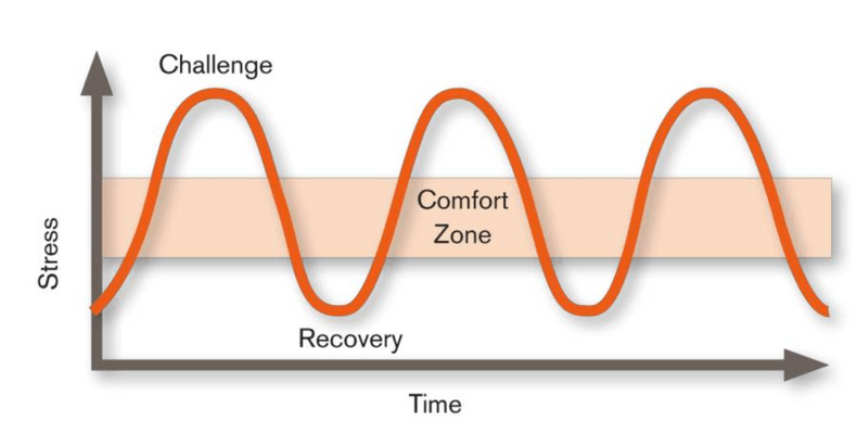
First of all, it should be emphasised here that stress alone is not the issue - it’s a good thing to challenge yourself and to escape from your comfort zone. However, if you are in constant stress, this is where burnout happens. On the contrary, constantly being in recovery is also not the answer - doing so will slow your progression and effectiveness, certainly in a work setting.
The best solution then is to try new things, take risks, dabble in the unknown and expose yourself to some stress, just make sure you prioritise your self-care either side of that. If you know you’re entering a stressful situation the following day, take some time the night before to pre-charge and prepare. If you are coming out of a stressful situation, dedicate some time to recharge, renew and recover your energy.
3. The Resilience Bank Account
We have all had times where we have reacted badly to a situation because we were ‘running on empty’. I know from experience that I look back on these situations with guilt and embarrassment, as I have acted so out of character when I didn’t have the energy to respond properly or effectively.
And so this one is really simple: imagine your level of resilience and energy in phone battery terms. You wouldn’t let your phone battery die, so don’t let your resilience bank account run low either. Think about ways to charge your battery effectively, and carve out some non-negotiable time to do that consistently. Recharging often will provide you with the resources to deal with life’s challenges adequately and appropriately.
Conclusions
The above frameworks broadly emphasise the same message - fit your own oxygen mask before fitting that of others. There is no silver bullet when it comes to managing stress and increasing resilience, however, self-awareness paired with deliberate, consistent action to recover and recharge is paramount.



Comments